



2026
Lyme disease
No one is safe from being bitten by a tick on a beautiful summer day. Here are the details...

Often eagerly awaited by parents-to-be, the nuchal translucency ultrasound can sometimes reveal your baby's sex! That said, certain very specific conditions have to be met.
Performed between the 11th and 14th week of pregnancy, this ultrasound is first and foremost an important medical exam. It is used to assess the risk of certain chromosomal abnormalities, such as trisomy 21.
But for a few years now, another question has been sparking curiosity among parents-to-be during this exam: can you guess the baby's sex at this stage?
The short answer: sometimes, yes, but with caution!
At this early stage, it's important to know that the fetus's genitals are not yet fully formed. Every fetus has a small genital bud, also called the genital tubercle. It's the angle of this bud, relative to the spine, that can give an indication of biological sex:
• Boy: the bud points upward, at an angle greater than roughly 30° relative to the spine.
• Girl: the bud is horizontal or points downward, at an angle of less than 30° relative to the spine.
Here is a diagram to help illustrate it:
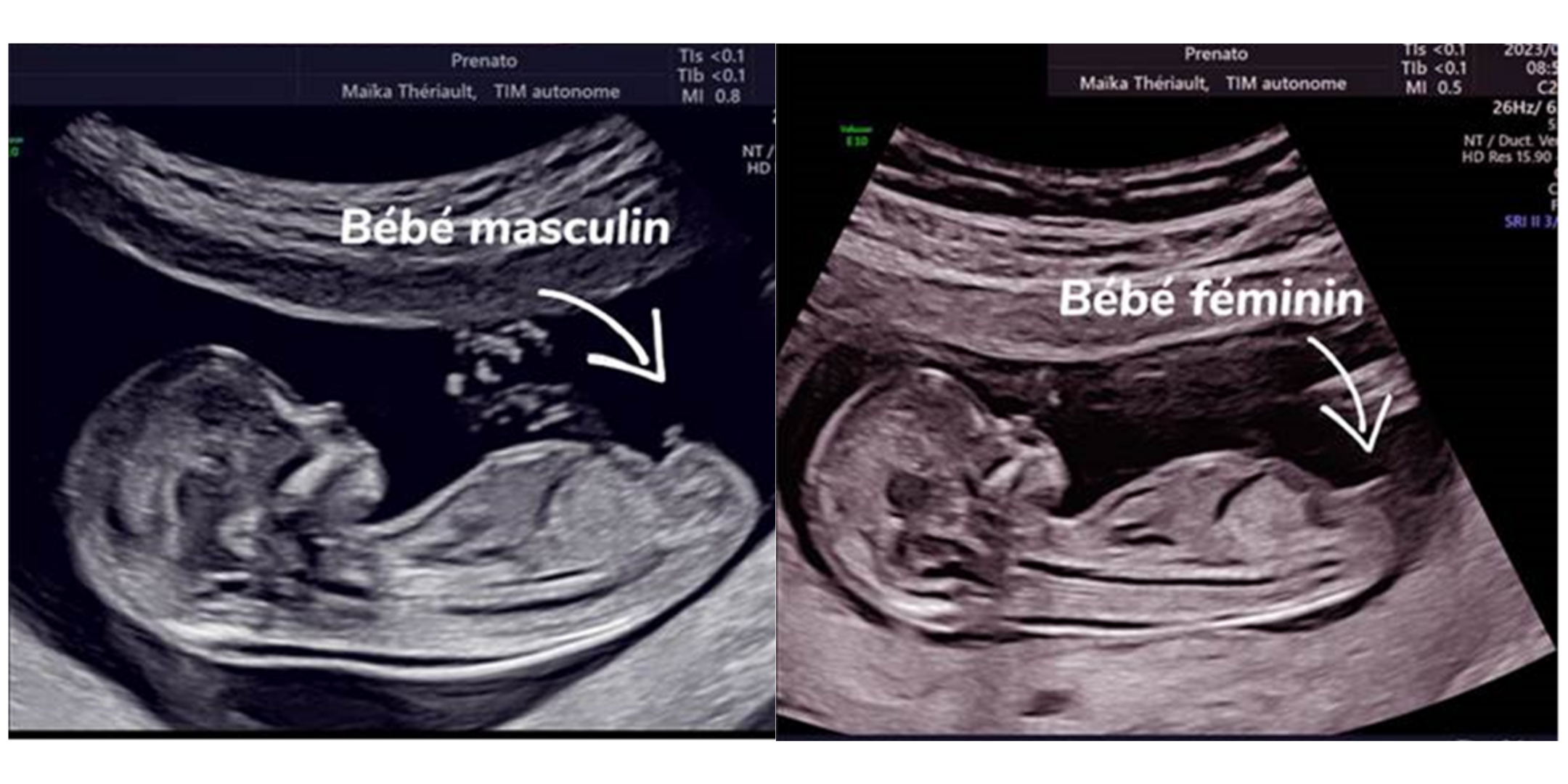
Even though this method has become very popular on social media and among parents, it's worth remembering that several things can affect how reliable it is:
Keep in mind that this method remains unofficial. Accuracy rates vary from one study to another, ranging from 70 to 95%, depending on the week of pregnancy and the technical conditions.
For that reason, many health care professionals point out that predicting sex from the angle of the bud at 12 weeks should be seen above all as a fun moment to share with curious parents-to-be, and not as a medical diagnosis.
The most reliable way to find out fetal sex at this stage is still non-invasive prenatal testing using cell-free fetal DNA (NIPT), done with a simple maternal blood draw from the 10th week of pregnancy. It can detect the presence or absence of the Y chromosome (the male chromosome) with over 99% accuracy.
It's also possible, as early as the 7th week, to determine fetal sex from a blood sample. An option that is just as reliable and safe!
If you don't go with this type of test, sex can be confirmed more reliably at the anatomy scan, done around 20 weeks.
In short, predicting your baby's sex at the nuchal translucency scan is a fun little tradition that fascinates many parents-to-be. But between the angle of the bud, the baby's position, image quality and the technologist's experience, misreadings are always possible. So take the prediction with a grain of salt, keeping in mind that it may well not be final. Either way it will be a lovely surprise, confirmed at 20 weeks or on the day your baby is born!
The prenato.ca website and the comprehensive information it contains are intended as practical tools for expectant and new parents, as well as for women throughout the various stages of their lives. This information is not intended to replace the skills, knowledge, or experience of qualified healthcare professionals who are familiar with the specific facts, circumstances, and symptoms of each individual. Consequently, Prenato and its staff cannot be held liable for any adverse effects or consequences resulting from the use of the information provided on this site. It is the user's responsibility to consult a physician or a qualified healthcare professional appropriate to their specific needs for any personal health concerns.
No one is safe from being bitten by a tick on a beautiful summer day. Here are the details...
Immerse yourself in the adventure of your pregnancy and follow your baby's journey through our personalized emails. Every two weeks, receive updates that are unique and tailored to your pregnancy, allowing you to track your little one's growth and development stages. Take advantage of valuable advice and information to accompany each magical moment of this adventure!
Prenato needs the contact information you provide to us in order to contact you about our products and services. You can unsubscribe from these communications at any time. See our Privacy Policy to learn more about how we unsubscribe, as well as our privacy policies and our commitment to protection and privacy.

From motherhood to menopause, Prenato accompanies each stage of your life with kindness, expertise and innovation.
