

















Benefits
Why choose Prenato?

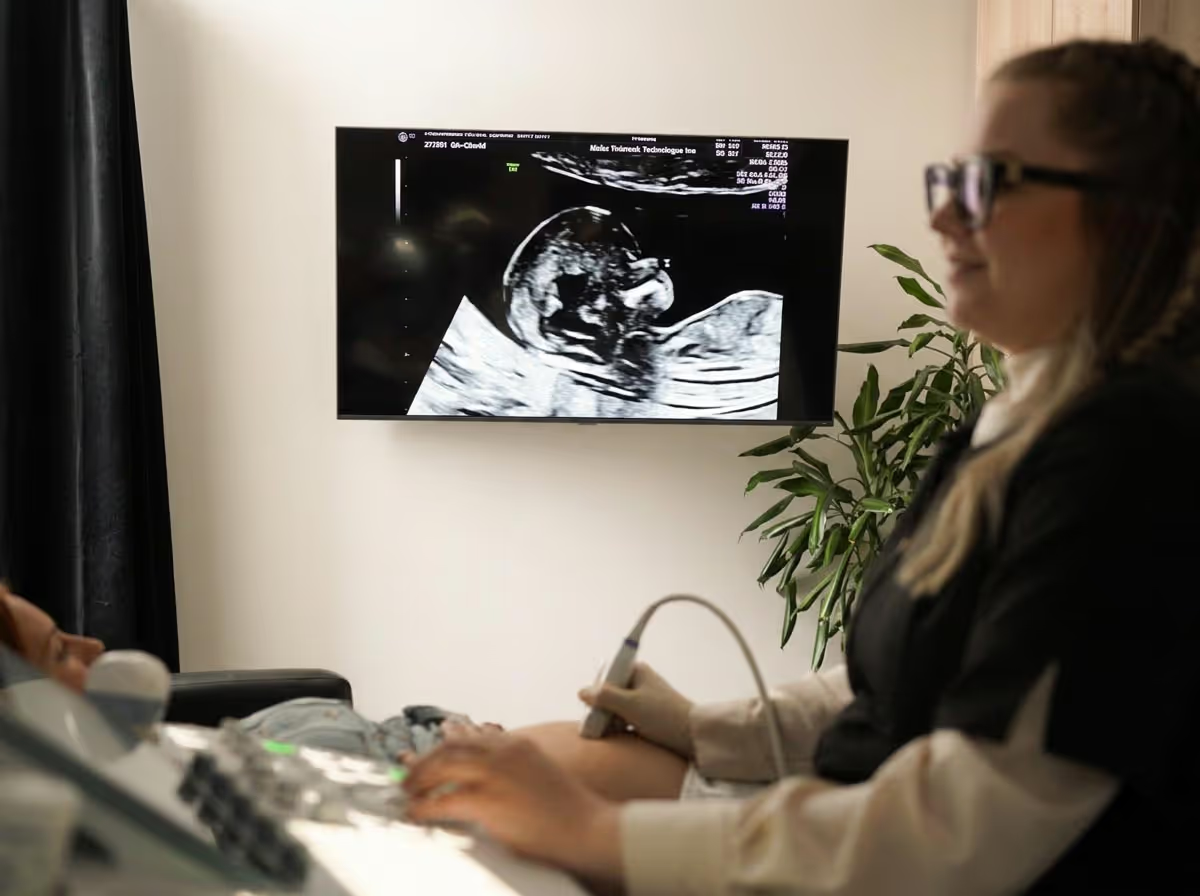
Ultrasounds are among the most important moments of pregnancy. At Prenato, they combine medical precision and human gentleness, to support you with confidence, at every stage!
Ultrasounds are precious moments for parents-to-be. Prenato offers you a complete range of ultrasounds, performed by technologists with experience in obstetric ultrasound. These professionals offer you a personalized experience while providing quality images to obstetrician-gynecologists, who will interpret them to make recommendations to your health professional.
As these are medical exams, a prescription is mandatory for each ultrasound service (with the exception of recreational (3D) ultrasounds).
Ultrasound exams at Prenato are reimbursable, in part or in full, by the majority of group insurances.
Performed from the 7th week of pregnancy, the purpose of viability ultrasound is to check that the pregnancy is progressing well and to ensure that the embryo is developing well in the uterus (and not outside it, as in the case of an ectopic pregnancy).
In particular, this ultrasound makes it possible to:
This ultrasound can also be done in the presence of acute pelvic pain, with or without bleeding.
Performed from the 7th week of pregnancy, the purpose of viability ultrasound is to check that the pregnancy is progressing well and to ensure that the embryo is developing well in the uterus (and not outside it, as in the case of an ectopic pregnancy).
In particular, this ultrasound makes it possible to:
This ultrasound can also be done in the presence of acute pelvic pain, with or without bleeding.
What are the criteria for accessing a viability ultrasound test?

In general, an early ultrasound to document the viability is indicated especially if there is a clinical concern, for example:
On the other hand, several guides emphasize that there is no need to do an ultrasound. only to confirm a pregnancy with no symptoms or risk factors.
Viability ultrasound is performed around 6 to 10 weeks, while the presence of cardiac activity and location can be checked.
Do I need a prescription for this ultrasound?
Yes, it is necessary to have a prescription for all medical ultrasounds.
It is possible to get your prescription with your doctor or directly from Prenato, depending on certain criteria. Our fast and accessible service allows you toget a prescription in just a few minutes during a virtual consultation.
Learn more about viability ultrasound
Viability ultrasound is mainly used to confirm that the pregnancy is progressing in the right place and at the right pace. It allows you to check if the pregnancy is well intrauterine, ofestimate the gestational age (dating) and to observe the first signs ofEvolution.
We often talk about viability ultrasound and dating ultrasound in the same time period, but the intention is not exactly the same. La viability aims to verify that the pregnancy seems to be progressing (according to what can be observed at this stage). La Dating, on the other hand, aims above all to establish the number of weeks of pregnancy as precisely as possible, which helps to plan the next follow-up.
What can be seen during this ultrasound depends a lot on the number of weeks. Cardiac activity usually becomes visible from around 6 to 7 weeks, especially if the ultrasound is done transvaginally. If you don't see activity very early on, this does not necessarily mean that there is a problem: sometimes, pregnancy is simply less advanced As expected, a follow-up ultrasound is then recommended.
At this stage, the baby is also Very small; we first observe the gestational sac, then the yolk sac, then the embryo. It is therefore normal not to see a baby clearly as you would expect.
Note that this ultrasound is generally not intended to detect abnormalities. Screening and more detailed evaluation of the anatomy are done later (in the 1st trimester), and especially duringmorphological ultrasound).
Can I get ahead of my viability ultrasound?
If you have unexplained bleeding, abdominal pain, or have had in vitro fertilization (IVF), your healthcare professional may want to have this ultrasound done earlier than week 7.
However, it is important to be aware that the embryo may not yet be visible or may not show viability, especially if your cycles are longer than 28 days (pregnancy less advanced than expected).
Performed between the 8th and 11th weeks of pregnancy, a dating ultrasound can confirm viability, locate the pregnancy, specify the gestational age and estimate the expected delivery date, based on certain measurements taken on your baby.
In particular, this ultrasound makes it possible to:
This ultrasound is no longer offered to the public right away. However, it is possible to ask your health professional if you want to do it privately, in order to be reassured.
Performed between the 8th and 11th weeks of pregnancy, a dating ultrasound can confirm viability, locate the pregnancy, specify the gestational age and estimate the expected delivery date, based on certain measurements taken on your baby.
In particular, this ultrasound makes it possible to:
This ultrasound is no longer offered to the public right away. However, it is possible to ask your health professional if you want to do it privately, in order to be reassured.
Do I need a prescription for this ultrasound?
Yes, it is necessary to have a prescription for all medical ultrasounds.
It is possible to get your prescription with your doctor or directly from Prenato, depending on certain criteria. Our fast and accessible service allows you toget a prescription in just a few minutes during a virtual consultation.
What are the contraindications to the teleconsultation service to obtain a prescription?
It is possible to obtain a telemedicine prescription at Prenato (including ultrasound examination, as indicated*).
However, it is impossible for us to provide you with a prescription if you have one or more of these situations:
The objective of this review is to Determine the position of the placenta in the uterus. This ultrasound is usually done in the 2nd or 3rd trimester, when a previous ultrasound showed a placenta too close to or over the cervix.
Past ultrasound reports are mandatory in order to schedule the appointment.
If you want to schedule a placental ultrasound, you should send your prescription and previous ultrasound report (if the exams were not done at Prenato) to info@prenato.ca. A member of our team will contact you to schedule the appointment.
The objective of this review is to Determine the position of the placenta in the uterus. This ultrasound is usually done in the 2nd or 3rd trimester, when a previous ultrasound showed a placenta too close to or over the cervix.
Past ultrasound reports are mandatory in order to schedule the appointment.
If you want to schedule a placental ultrasound, you should send your prescription and previous ultrasound report (if the exams were not done at Prenato) to info@prenato.ca. A member of our team will contact you to schedule the appointment.
What is the purpose of this review?
The purpose of this examination is to determine the position of the placenta in the uterus. This ultrasound is usually done during the 2nd trimester ultrasound but could be repeated in the 3rd trimester vaginally when a previous ultrasound showed a placenta too close to or over the cervix.
How do I schedule my appointment?
If you want to schedule an ultrasound, you should send your prescription and previous ultrasound report (if the exam was not done at Prenato) to info@prenato.ca. A member of our team will contact you to schedule the appointment.
The aim of this examination is to measure the length of the cervix. This ultrasound is requested when a risk of the short cervix could be present, which could cause premature delivery.
Past ultrasound reports are mandatory in order to schedule the appointment.
The aim of this examination is to measure the length of the cervix. This ultrasound is requested when a risk of the short cervix could be present, which could cause premature delivery.
Past ultrasound reports are mandatory in order to schedule the appointment.
How do I schedule my appointment?
If you want to schedule an ultrasound, you should send your prescription and previous ultrasound report (if the exam was not done at Prenato) to info@prenato.ca. A member of our team will contact you to schedule the appointment.
This ultrasound is recommended for all pregnant women, regardless of the type of prenatal blood screening chosen.
It allows you to measure your baby, to capture images and videos in order to detect possible abnormalities, as well as to analyze the maternal pelvic anatomy, including the uterus and the ovaries.
It is carried out between 11 4/7 and 14 weeks, ideally from 12 3/7 weeks.
At Prenato, this ultrasound allows you to:
This ultrasound is recommended for all pregnant women, regardless of the type of prenatal blood screening chosen.
It allows you to measure your baby, to capture images and videos in order to detect possible abnormalities, as well as to analyze the maternal pelvic anatomy, including the uterus and the ovaries.
It is carried out between 11 4/7 and 14 weeks, ideally from 12 3/7 weeks.
At Prenato, this ultrasound allows you to:
What is nuchal translucency?
Nuchal translucency is a measure of the subcutaneous space in the neck of the fetus. It is an important marker in the analysis of the risk of Down Syndrome, especially in the context of screening using serum markers.
This ultrasound is a routine exam available to all pregnant women in Quebec. Also called “morphology ultrasound”, it is the most complete examination of pregnancy. It makes it possible to observe all of the baby's organs in order to detect abnormalities, while ensuring that its growth is optimal.
It is carried out between the 19th and 23rd weeks, and highly recommended between 21 and 22 6/7 weeks.
This ultrasound allows you to:
This ultrasound is a routine exam available to all pregnant women in Quebec. Also called “morphology ultrasound”, it is the most complete examination of pregnancy. It makes it possible to observe all of the baby's organs in order to detect abnormalities, while ensuring that its growth is optimal.
It is carried out between the 19th and 23rd weeks, and highly recommended between 21 and 22 6/7 weeks.
This ultrasound allows you to:
This ultrasound is generally recommended for certain specific indications. It is not necessarily offered to all pregnant women.
This ultrasound allows you to:
Some requests for 3rd trimester ultrasounds with specific features (high-risk pregnancy or specific previous ultrasounds) could be refused at Prenato and directed to a hospital center to ensure faster care if necessary.
This ultrasound is generally recommended for certain specific indications. It is not necessarily offered to all pregnant women.
This ultrasound allows you to:
Some requests for 3rd trimester ultrasounds with specific features (high-risk pregnancy or specific previous ultrasounds) could be refused at Prenato and directed to a hospital center to ensure faster care if necessary.
How do I schedule my appointment?
If you want to schedule an ultrasound, you should send your prescription and previous ultrasound report (if the exam was not done at Prenato) to info@prenato.ca. A member of our team will contact you to schedule the appointment.
The limited study is offered primarily to people who have not been able to get a nuchal translucency ultrasound in a timely manner. This examination makes it possible to take various measurements and to visualize certain anatomical structures of the baby, in order to detect certain morphological abnormalities.
It is generally performed between the 14th and 18th weeks of pregnancy.
This ultrasound allows you to:
The limited study is offered primarily to people who have not been able to get a nuchal translucency ultrasound in a timely manner. This examination makes it possible to take various measurements and to visualize certain anatomical structures of the baby, in order to detect certain morphological abnormalities.
It is generally performed between the 14th and 18th weeks of pregnancy.
This ultrasound allows you to:
Often called basic ultrasound or follicular count, this ultrasound makes it possible to assess the uterus and its appendages (ovaries) between day 2 and 5 of the menstrual cycle.
It is an ultrasound that is performed endovaginally.
In particular, this ultrasound makes it possible to:
Ovarian reserve naturally decreases with age, but it varies from woman to woman. Age alone is therefore not a reliable indicator. It is often combined with blood tests (FSH, LH, Estradiol, Inhibin B, AMH) for a comprehensive evaluation.
Often called basic ultrasound or follicular count, this ultrasound makes it possible to assess the uterus and its appendages (ovaries) between day 2 and 5 of the menstrual cycle.
It is an ultrasound that is performed endovaginally.
In particular, this ultrasound makes it possible to:
Ovarian reserve naturally decreases with age, but it varies from woman to woman. Age alone is therefore not a reliable indicator. It is often combined with blood tests (FSH, LH, Estradiol, Inhibin B, AMH) for a comprehensive evaluation.
This ultrasound is used to measure the thickness of the endometrium and assess mature follicles (number and size).
This test is usually requested before an egg puncture or an embryo transfer.
It is an ultrasound that is performed endovaginally.
This ultrasound is used to measure the thickness of the endometrium and assess mature follicles (number and size).
This test is usually requested before an egg puncture or an embryo transfer.
It is an ultrasound that is performed endovaginally.
Why do this ultrasound?
Performed under medical prescription and endovaginally, this ultrasound makes it possible to follow the evolution of the follicles during the cycle.
It is usually done around day 10 of a 28-day cycle, then repeated every 2 days in order to:
The report is then sent to your doctor in order to adjust the treatment as needed.
Generally, ovarian reserve ultrasound does not have to be repeated every cycle, unlike follicular monitoring, which is adapted according to the results obtained.
This is a medical imaging procedure to determine whether or not there is a blockage in the fallopian tubes, by injecting liquid or air into them.
This is a medical imaging procedure to determine whether or not there is a blockage in the fallopian tubes, by injecting liquid or air into them.
How does the exam take place?
You will first be installed in a gynecological position in order to take the first images. A speculum is then inserted to allow the cervix to be cleaned and disinfected, then a catheter with a small balloon is gently put in place.
Afterwards, a mixture of liquid and air is gently injected, followed by new imaging to observe the passage through the tubes. This examination makes it possible to visualize the shape of the uterus, to detect possible abnormalities (such as polyps, fibroids or adhesions) and to assess the circulation of fluid in the tubes.
What can happen after the exam
After the exam, it is possible to experience mild cramps, slight bleeding, or, more rarely, shoulder pain. These symptoms are usually short lived and go away quickly. However, it is recommended that you consult your doctor if you experience persistent pain, fever, or abnormal discharge.
Like any medical exam, some risks should be considered, although they remain rare, such as mild discomfort, cramps, a vagal reaction or an infection.
This examination is contraindicated in case of ongoing pregnancy or active gynecological infection.
What should I do if I think I am pregnant?
Obviously, this procedure could not be done if there is a chance that you are pregnant. First, the examination is carried out at a specific point in the cycle. In all cases, a urine pregnancy test should be performed prior to the procedure. In addition, you must avoid an unprotected sexual relationship in the 5 days preceding the intervention.
Is the procedure painful?
Some women will experience sharp pain and others will experience simple discomfort. We recommend taking 2 acetaminophens and 2 ibuprofens (if you have no contraindications to taking these medications) 1 hour before the appointment.
We also strongly suggest that you be accompanied during the appointment.
*Note: A $30 fee will be applied when the file is opened and analyzed. A valid prescription is required for all screening tests.
Immerse yourself in the adventure of your pregnancy and follow your baby's journey through our personalized emails. Every two weeks, receive updates that are unique and tailored to your pregnancy, allowing you to track your little one's growth and development stages. Take advantage of valuable advice and information to accompany each magical moment of this adventure!
Prenato needs the contact information you provide to us in order to contact you about our products and services. You can unsubscribe from these communications at any time. See our Privacy Policy to learn more about how we unsubscribe, as well as our privacy policies and our commitment to protection and privacy.

We offer you adapted time slots, for a smooth and pleasant experience, in a warm atmosphere. After your ultrasound, leave with a few printed souvenir photos, which you can choose from.
Our team of nurses remains available for you if needed. They will be able to assist you and answer your questions. And if the situation required it, follow up quickly with your treating professional.
Can I be accompanied?
Yes Most of our appointments allow the presence of a companion (depending on the service and the space in the clinic). The presence of a child is allowed only if another adult accompanies you.
At what point during the pregnancy should I book my ultrasound appointments?
Availability varies depending on the service and the number of weeks pregnant. When booking, you will be offered the various options adapted to your situation.
How long does the appointment last?
The length varies depending on the service and the type of pregnancy, but the majority of appointments last between 30 and 60 minutes.
Is it covered by RAMQ or private insurance?
Our ultrasounds are not covered by the RAMQ. However, some insurance companies may reimburse all or part of the costs. We recommend that you check directly with your insurance company.
Do I need a prescription?
A prescription is required for all medical ultrasounds. Only recreational (3D) ultrasounds do not require a prescription.
When will I get my results?
Deadlines vary depending on the type and result of the exam. The report will be sent to your treating professional only.

Early pregnancy dating ultrasound confirms gestational age and viability.

Get a prescription for your viability or dating ultrasound at Prenato.

Should you drink water before an ultrasound? It depends on the type, here's how to prepare for it.
Why choose Prenato?

Our team of doctors, gynecologists, technologists and nurses has been supporting women for over 10 years.

Each woman is unique. We adapt our follow-ups and advice to your age, your needs and your health priorities.

Fast DNA screening, 3D/4D ultrasounds and digital tools for reliable and modern monitoring.

Our clinics offer a reassuring, human and attentive environment, designed for the comfort of patients and their families.

More than 100,000 families supported in Quebec attest to the quality and humanity of our services.

Fast online appointment scheduling, teleconsultations available and clinics in several regions.

Medical imaging technologist - Brossard Clinic
.avif)
Medical imaging technologist - Quebec Clinic

Medical imaging technologist - Brossard and Montreal Clinics

Signing gynecologist - Holds a postdoctoral fellowship in maternal-fetal medicine

Signing gynecologist - Holds a doctorate in gynecology-obstetrics with a subspecialty in first-trimester ultrasound
.avif)
Signing gynecologist - Holds a postdoctoral fellowship in maternal-fetal medicine

Signing gynecologist - Holds a doctorate in gynecology-obstetrics and a fellowship in obstetric and gynecologic ultrasound

Holds a doctorate in gynecology-obstetrics

Signing gynecologist - Holds a postdoctoral fellowship in maternal-fetal medicine

Medical imaging technologist - Quebec Clinic

Medical imaging technologist - Blainville Clinic

Medical imaging technologist - Quebec Clinic

Medical imaging technologist - Blainville Clinic

Medical imaging technologist - Brossard Clinic

From motherhood to menopause, Prenato accompanies each stage of your life with kindness, expertise and innovation.